Economy Plumbing Services logo
ECONOMY PLUMBING SERVICES
Austin and Marble Falls service since 2012
Home
Contact FormSchedule AppointmentFAQ
About UsSuccess StoriesBlogVIP MembershipCustomer Portal
Service Areas
All Service AreasAustinCedar ParkLeanderRound RockGeorgetownPflugervilleLiberty HillBudaKyleMarble FallsBurnetHorseshoe BayKingslandGranite ShoalsBertramSpicewood
All ServicesEmergency PlumbingWater Heater ServicesWater Heater GuideDrain CleaningHydro JettingRooter ServicesLeak RepairToilet & FaucetFaucet InstallationGarbage DisposalGas Line ServicesGas Leak DetectionBackflow TestingDrainage SolutionsSump & Sewage PumpsWater Leak RepairWater Pressure SolutionsSewer Line RepairRepiping ServicesPermit ResolutionFixture InstallationCommercial PlumbingRestaurant PlumbingRetail PlumbingOffice BuildingsProperty ManagementAirbnb & Rental PropertiesWinter Freeze ProtectionSummer Plumbing Prep
Customer PortalReferral ProgramPlumbing Cost EstimatorWater Heater CalculatorVIP MembershipProducts
Just For Fun
Dogs Doing PlumbingCats Doing Plumbing
Privacy PolicyTerms of ServiceRefund & Returns
(512) 368-9159Call
  1. Home
  2. /
  3. Services
  4. /
  5. Water Heater Buying Guide
Water heater buying guide and selection help in Central Texas

Professional plumbing service

Water Heater Buying Guide

Choose the Perfect Water Heater for Your Home

Call Now: (512) 368-9159
What to expect

Expert guidance from licensed professionals

Tank vs tankless detailed comparison

Accurate sizing recommendations

Energy efficiency ratings explained

Service overview

Complete Water Heater Selection Guide

Choosing the right water heater is a major investment that affects your daily comfort, energy bills, and home value. With so many options available—tank vs tankless, gas vs electric, traditional vs high-efficiency—making the right choice can be overwhelming. Our comprehensive guide breaks down everything you need to know to make an informed decision for your specific needs, budget, and home in Central Texas.

Expert guidance from licensed professionals

Tank vs tankless detailed comparison

Accurate sizing recommendations

Energy efficiency ratings explained

Total cost of ownership analysis

Brand recommendations and reviews

Free in-home consultation

Professional code-compliant installation

Warranty information comparison

Rebates and incentives guidance

Regional considerations for Texas climate

Long-term savings calculations

What we handle

Understanding Your Water Heater Options

InstallationRepairReplacement

Traditional Tank Water Heaters

Storage tank heaters are the most common and affordable option. They store 30-80 gallons of pre-heated water, providing reliable hot water on demand. Gas models offer faster recovery times and lower operating costs but require venting. Electric models are simpler to install with no venting required. Average lifespan: 10-12 years. Best for: Families with predictable usage patterns, budget-conscious buyers, and homes with adequate space.

Tankless (On-Demand) Water Heaters

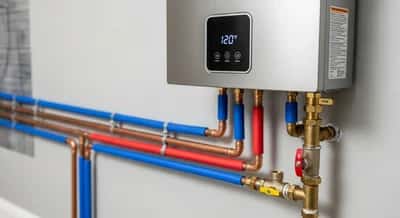
Tankless heaters heat water instantly as it flows through the unit, providing endless hot water without storage. They're 24-34% more energy efficient than tanks, save space with wall-mounted installation, and last 20+ years. Higher upfront cost ($2,500-$4,500) is offset by energy savings and longevity. Gas models deliver higher flow rates; electric models work for smaller applications. Best for: property owners wanting maximum efficiency, unlimited hot water, space savings, and long-term value.

Heat Pump (Hybrid) Water Heaters

These innovative heaters use heat pump technology to transfer heat from surrounding air to the water, making them 2-3 times more efficient than standard electric tanks. They require adequate space (700+ cubic feet of air) and work best in warm climates like Texas. Higher purchase cost ($1,800-$3,500) is offset by utility rebates (up to $500) and 60% lower energy costs. Lifespan: 10-15 years. Best for: efficiency-focused property owners with adequate space in warm areas.

Solar Water Heaters

Solar thermal systems use roof-mounted collectors to capture sun energy for water heating, reducing energy costs by 50-80%. Active systems use pumps to circulate water; passive systems rely on natural convection. Requires backup electric or gas heater for cloudy days. High upfront cost ($5,000-$10,000) but qualifies for 30% federal tax credit and Texas rebates. Lifespan: 15-20 years. Best for: property owners in sunny climates with long-term plans and strong efficiency goals.

High-Efficiency Tank Heaters

These improved traditional tanks feature better insulation, more efficient burners/elements, and advanced controls. They offer 10-20% better efficiency than standard tanks at a modest price premium ($200-$400 more). Energy Star certified models qualify for rebates. Easier to install than tankless with lower upfront cost. Lifespan: 10-13 years. Best for: property owners wanting improved efficiency without the cost and complexity of tankless or heat pump systems.

Condensing Water Heaters

Available in tank and tankless models, condensing heaters capture and reuse heat from exhaust gases, achieving 90-98% efficiency compared to 60-70% for standard gas heaters. They require drain for condensate and special venting. Higher efficiency means lower gas bills. Premium upfront cost offset by energy savings. Best for: Homes with high hot water usage seeking maximum gas efficiency and willing to invest in advanced technology.

Point-of-Use Water Heaters

Small electric or gas heaters installed near specific fixtures (sink, shower) provide instant hot water without waiting for water to travel from main heater. They reduce water waste and can supplement or replace central systems. Compact units (2.5-20 gallons) are inexpensive ($150-$500). Best for: Remote fixtures, bathroom additions, reducing wait times, supplementing low-capacity systems, and reducing water waste.

Smart Water Heaters

Modern heaters with WiFi connectivity and smartphone apps allow remote monitoring, leak detection, temperature adjustment, and usage tracking. Some models learn usage patterns and adjust heating schedules for maximum efficiency. Smart features add $200-$500 to cost. Available in tank and tankless models from brands like Rheem, AO Smith, and Rinnai. Best for: people who want remote control, usage insights, leak alerts, and optimized efficiency.

Common warning signs

Key Factors to Consider Before Buying

Fuel Type Availability

Your home's existing utilities determine options. Gas heaters need gas line and proper venting. Electric heaters require adequate electrical service (sometimes 240V upgrade needed). Changing fuel types adds significant installation cost.

Installation Location & Space

Tank heaters need floor space (2x3 feet minimum). Tankless mount on walls saving space but require specific venting. Heat pumps need 700+ cubic feet air space. Consider access for maintenance and future replacement.

Venting Requirements

Gas heaters require proper venting (atmospheric, power vent, direct vent, or condensing). Venting type affects installation cost and location options. Improper venting is dangerous—always use professionals for gas installations.

Water Quality & Hardness

Central Texas has very hard water causing scale buildup. Tankless heaters are more sensitive to hard water requiring annual descaling. Water softeners extend heater life. Consider water quality when choosing tank vs tankless.

Upfront vs Operating Costs

Cheaper upfront options may cost more long-term. Calculate total cost of ownership including purchase, installation, energy costs (over 10-20 years), and maintenance. Higher efficiency pays back over time through lower utility bills.

Available Rebates & Incentives

Energy-efficient models qualify for federal tax credits (up to 30%), utility rebates ($100-$500), and manufacturer rebates. These incentives can offset 10-30% of purchase cost making efficient options more affordable.

Family Size & Usage Patterns

Large families, teenagers, simultaneous use (morning rush), and luxury fixtures (rainfall showers, soaking tubs) require higher capacity. Empty nesters may benefit from downsizing. Consider current needs and 5-year plans.

Energy Efficiency Goals

If reducing carbon footprint and utility bills are priorities, invest in high-efficiency options. Energy Star certified models use 10-50% less energy. Consider payback period—typically 3-7 years for efficient upgrades.

Warranty & Longevity

Warranty length indicates manufacturer confidence. Residential warranties range 3-12 years for tanks, 10-15 years for tankless. Longer warranties cost more upfront but provide peace of mind. Extended warranties available.

More to know

How to Size Your Water Heater Correctly

Proper sizing is critical for comfort and efficiency. An undersized heater leaves you with cold showers; an oversized one wastes energy and money.

**Tank Water Heater Sizing (First Hour Rating Method):** Calculate your peak hour demand by identifying your busiest hot water hour (typically morning). Add up gallons used: shower (10-20 gallons), shaving (2 gallons), washing hands/face (2 gallons), dishwasher (14 gallons), washing machine (32 gallons). Match your peak demand to the heater's First Hour Rating (FHR), not just tank capacity.

General guidelines: 1-2 people need 30-40 gallons (FHR 40-50), 2-3 people need 40-50 gallons (FHR 50-70), 3-4 people need 50-60 gallons (FHR 70-90), 5+ people need 60-80 gallons (FHR 90-120+). Families with teenagers, multiple bathrooms, or simultaneous usage need higher capacity.

**Tankless Water Heater Sizing (Flow Rate Method):** Calculate required flow rate (GPM - gallons per minute) by adding simultaneous uses: shower (2.5 GPM), bathroom sink (0.5 GPM), kitchen sink (1.5 GPM), dishwasher (1.5 GPM), washing machine (2.0 GPM). For example, simultaneous shower + kitchen sink = 4 GPM minimum.

Then factor in temperature rise: subtract incoming groundwater temperature from desired output temperature. Central Texas groundwater averages 65-70°F. For 120°F output, you need 50-55°F temperature rise. Higher rises require more powerful units or lower flow rates.

General guidelines: Small homes (1-2 bath) need 5-7 GPM, Medium homes (2-3 bath) need 7-9 GPM, Large homes (3-4+ bath) need 9-11+ GPM or multiple units. Consider whole-house systems for main needs plus point-of-use units for remote fixtures.

**Professional Assessment:** Our technicians perform detailed assessments considering occupancy, peak usage patterns, simultaneous usage, fixture types, existing plumbing, and future needs. We don't just follow formulas—we analyze your actual hot water habits to recommend the perfect size. Proper sizing saves money upfront and long-term through optimal efficiency.

**Cost vs Value Analysis:** While it's tempting to oversize "just in case," oversized tank heaters waste energy maintaining extra hot water you don't use. Oversized tankless heaters cost more without benefit. Right-sizing balances capacity, efficiency, and cost for the best value.

Care and upkeep

Maximizing Your Water Heater Investment

Annual Professional Maintenance

Schedule yearly professional service including tank flushing, anode rod inspection, burner cleaning, safety testing, and efficiency check. Preventive maintenance costs $100-$200 but prevents $500-$2,000 repairs and extends lifespan 3-5 years.

Regular Tank Flushing (DIY or Pro)

Flush tank annually to remove sediment. In Central Texas with hard water, consider every 6 months. DIY flushing saves money but professional service ensures thorough cleaning. Sediment reduces efficiency by 20-30% and shortens lifespan.

Anode Rod Replacement

Check anode rod every 3 years; replace when depleted (core wire exposed over 6 inches). Anode rods ($20-$50 parts) protect tank from corrosion. Replacing extends tank life 5+ years. One of the most important maintenance tasks people neglect.

Water Softener Installation

Consider whole-home water softener for Central Texas hard water. Softeners reduce scale buildup in heaters, pipes, and fixtures. Initial cost ($800-$2,500) pays back through extended appliance life, lower maintenance, and better efficiency.

Temperature Optimization

Set temperature to 120°F for efficiency and safety. Higher temps increase energy use and scalding risk. Lower temps risk Legionella bacteria growth. 120°F balances safety, comfort, and efficiency while reducing mineral buildup.

Expansion Tank Installation

Install expansion tank if not present (required by code in many areas). Prevents pressure damage to heater and plumbing. Especially important with tankless systems. Installation costs $200-$400 but prevents costly damage.

Monitor for Warning Signs

Watch for rust-colored water, strange noises, leaks, insufficient hot water, or pilot light problems. Early detection prevents minor issues from becoming major failures. Address problems promptly to avoid water damage and emergency replacements.

Keep Area Clear & Clean

Maintain 2 feet clearance around heater for ventilation, fire safety, and service access. Never store flammables nearby. Keep area clean and dry. Good access speeds repairs and maintenance, reducing service costs.

FAQ

Frequently Asked Questions

Tank or tankless: which is better for my home?
There's no universal 'better' option—it depends on your priorities. Choose tankless if you: have high hot water usage, want endless supply, prioritize efficiency and space savings, plan to stay long-term (to recoup higher upfront cost), and can afford $2,500-$4,500. Choose tank if you: have moderate usage, want lower upfront cost ($1,200-$2,500), prefer simpler technology and maintenance, need high simultaneous flow (multiple showers), or have limited installation budget. Both work excellently when properly sized and maintained.
What size water heater do I really need?
Size depends on occupancy and usage patterns, not just number of people. For tank heaters: match First Hour Rating (FHR) to peak hourly demand. Small families (1-2 people) typically need 40-50 gallon tanks (FHR 50-70). Medium families (3-4 people) need 50-60 gallons (FHR 70-90). Large families (5+ people) need 60-80 gallons (FHR 90-120+). For tankless: calculate simultaneous GPM usage. Single bathroom homes need 5-7 GPM, two bathroom homes need 7-9 GPM, three+ bathrooms need 9-11+ GPM. We perform detailed assessments considering shower heads, fixtures, appliances, and usage patterns to recommend the perfect size—not too small (cold showers) or too large (wasted money and energy).
Gas or electric water heater—which costs less to operate?
Gas costs less to operate in most areas but costs more to install. In Central Texas, natural gas costs approximately $0.50-$0.75 per therm while electricity costs $0.11-$0.13 per kWh. For a typical family, annual operating costs are: gas tank $200-$300, electric tank $450-$600, gas tankless $150-$200, electric tankless $300-$400. Gas heats faster and recovers quicker. Electric is simpler to install with no venting. If you have gas available, it typically saves $150-$300 annually in operating costs, paying back higher installation cost in 2-4 years. If you don't have gas, adding a gas line costs $500-$2,000+, making electric more practical.
How much does a new water heater actually cost installed?
Total installed costs in Central Texas typically range: Standard 40-50 gallon electric tank $1,200-$1,800; Standard 40-50 gallon gas tank $1,400-$2,200; High-efficiency tank $1,800-$2,800; Gas tankless whole-house $2,800-$4,500; Electric tankless (whole-house) $2,500-$4,000; Heat pump (hybrid) $2,200-$3,800; Point-of-use electric $400-$800. Costs include unit, labor, permits, code compliance, haul-away, and basic accessories. Additional costs for: gas line upgrades ($500-$2,000), electrical upgrades ($300-$1,500), venting modifications ($300-$1,200), expansion tanks ($200-$400), and water softeners ($800-$2,500). Get detailed written estimates including all costs—beware low quotes that exclude necessary work.
What are the most reliable water heater brands?
Top-tier brands known for reliability: Rheem (excellent warranty and nationwide service), AO Smith (industry leader, made in USA), Bradford White (commercial-grade quality for residential), Rinnai (tankless specialist with excellent support), Navien (innovative features, good efficiency), and Noritz (commercial-grade tankless). Good mid-tier options: State, American, Kenmore. Avoid: store-brand budget models with short warranties and limited support. We recommend brands with: strong warranty (6+ year tank, 1+ year parts), local service availability, consistent parts supply, and proven track record. Specific recommendations depend on your needs and budget—we'll explain pros and cons of options suitable for your situation.
How long will my water heater last?
Expected lifespan varies by type, quality, maintenance, and water conditions. Tank water heaters: 8-12 years (standard models), 10-13 years (high-efficiency models). Tankless water heaters: 15-20+ years. Heat pump heaters: 10-15 years. Solar systems: 15-20 years (collectors). Central Texas's hard water reduces lifespan without maintenance. Factors extending life: regular flushing (removes sediment), anode rod replacement (prevents corrosion), water softener (reduces scale), proper temperature setting (120°F reduces stress), and professional maintenance (catches problems early). Neglected heaters often fail at 6-8 years. Well-maintained units can exceed expected lifespan by 3-5 years, saving thousands in premature replacement costs.
Are tankless water heaters worth the extra cost?
Tankless heaters cost $1,000-$2,500 more than comparable tanks but provide: 20-34% energy savings ($150-$250 annually), 20+ year lifespan (vs. 10-12 for tanks), endless hot water (no running out), space savings (wall-mounted), and higher property value. Break-even is typically 5-8 years. Over 20-year lifespan, tankless can save $3,000-$5,000 in energy and replacement costs. They're worth it if you: use lots of hot water, want endless supply, plan to stay 5+ years, have space constraints, prioritize efficiency, or can afford higher upfront cost. Not worth it if: you're budget-limited, selling soon, have low usage, or prefer simpler technology. For many property owners, especially those staying long-term, tankless is excellent value despite higher initial cost.
Can I install a water heater myself to save money?
We strongly discourage DIY water heater installation except for point-of-use electric models under 20 gallons. Here's why: Gas installations require proper venting (carbon monoxide risk), gas line connections (explosion/fire risk), and permit/inspection (code compliance). Electric installations need correct wiring (fire risk), proper grounding (shock risk), and code compliance. Tankless requires precise gas/electrical sizing, proper venting, water line configuration, and complex setup. Improper installation voids warranties, creates safety hazards, violates codes, and causes insurance issues. Professional installation costs $300-$800 but includes: code compliance, permits/inspections, proper sizing/venting, warranty coverage, liability insurance, and quality guarantee. DIY 'savings' evaporate with one callback or when warranty is denied. Use licensed professionals for all installations except smallest point-of-use units.
What government rebates and tax credits are available?
Federal Tax Credits (through Inflation Reduction Act): Heat pump water heaters qualify for 30% credit (up to $2,000). High-efficiency gas/tankless may qualify for smaller credits. Texas Utility Rebates: Many utilities offer $100-$500 for Energy Star models. Austin Energy offers rebates for heat pump and tankless heaters. City of Austin utilities provides additional incentives. Manufacturer Rebates: Brands periodically offer $50-$300 rebates on select models. HOA/Solar Incentives: 30% federal credit on solar water heaters (through 2032). Combining incentives can reduce costs 20-40%. Examples: $2,500 heat pump heater with $750 federal credit and $300 utility rebate nets $1,450. Requirements vary—we help identify applicable rebates and handle paperwork. Keep receipts and documentation for tax filing.
How does hard water in Central Texas affect water heaters?
Central Texas has some of the hardest water in the nation (200-300+ PPM minerals) causing: accelerated sediment buildup (reduces efficiency 20-30%, shortens lifespan), scale on heating elements (increases energy use, causes failure), reduced flow in tankless heat exchangers (expensive repairs), and corroded anode rods (faster tank deterioration). Solutions: Annual professional flushing ($100-$200), more frequent anode rod replacement (every 2-3 years vs. 5 years), descaling tankless heaters annually ($150-$250), whole-home water softener installation ($800-$2,500 upfront, $5-$15/month salt), and choosing models designed for hard water. Softeners are single best investment for appliance longevity in our area—they extend water heater life 3-5 years and pay for themselves through reduced maintenance and energy savings.
What's the difference between recovery rate and capacity?
Capacity is how much hot water the tank holds (30-80 gallons). Recovery rate is how quickly it reheats after use (gallons per hour). A 50-gallon tank doesn't provide 50 gallons of hot water continuously—it provides its capacity plus what it can reheat during use. First Hour Rating (FHR) combines both: how much hot water delivered in first hour of peak use. Example: 50-gallon gas heater with 40 GPH recovery has FHR of 70 gallons (50 stored + 20 reheated in first hour). Two 50-gallon heaters can have vastly different FHR—always check FHR, not just capacity. Gas heaters have faster recovery (35-50 GPH) than electric (12-23 GPH). This is why you should size based on FHR matching peak demand, not just tank size matching family size.
Should I repair or replace my aging water heater?
Replace if: unit is 10+ years old, repairs exceed 50% of replacement cost, tank is leaking, major component failure (heat exchanger, tank, gas valve), frequent repairs (2+ in past year), rising energy bills (efficiency declining), or you're planning home sale (old heaters are red flags). Repair if: unit under 8 years old, simple fix (thermostat, heating element, pressure relief valve), single isolated issue, repair under $300-$400, and you're budget-limited. Gray area (8-10 years, $400-$600 repair): consider efficiency of new models, remaining warranty, and total cost of ownership. We provide honest assessments with repair vs. replace comparison including costs, expected remaining life, and recommendations. We don't push unnecessary replacements—but we won't bandaid a failing unit either.

Ready to get started?

Contact Economy Plumbing Services today for reliable, professional service.

Reach Austin or Marble Falls directly, or schedule online when you are ready.

Austin: (512) 368-9159Marble Falls: (830) 460-3565

Free estimate

Request Your Free Estimate

Fill out the form below and we'll contact you within 1 hour during business hours to discuss your plumbing needs.

Service Address (Optional - helps us serve you better)

Communication Preferences (Optional)

We respect your privacy. Your contact information will never be sold or shared with third parties.

Or call us directly at (512) 368-9159 (Austin)

Keep exploring

Related Plumbing Services

Explore our other professional plumbing services to find the solution you need.

Water Heater Services

Water Pressure Solutions

Gas Line Services

Emergency Plumbing

Need plumbing help?

Schedule service online or call the office and we'll get you where you need to go.

Book in minutes, talk to a real person, or use the links below to jump straight to the right service or service area.

Schedule ServiceCall Now: (512) 368-9159
Economy Plumbing Services

Central Texas' Best Little Plumbing Company Since 2012.

Texas Master Plumber License #M-41147

Visit our Facebook pageVisit our Instagram pageVisit our Yelp pageVisit our Nextdoor page
Careers
Austin OfficeMarble Falls Office

Services

  • Emergency Plumbing
  • Water Heater Services
  • Water Heater Guide
  • Water Heater Calculator
  • Cost Estimator
  • Drain Cleaning
  • Leak Repair
  • Sewer Line Repair
  • Repiping
  • Fixture Install
  • Toilet & Faucet
  • Gas Services
  • Backflow
  • Commercial Plumbing
  • All Plumbing Services

Service Areas

  • Austin
  • Cedar Park
  • Leander
  • Round Rock
  • Georgetown
  • Pflugerville
  • Liberty Hill
  • Buda
  • Kyle
  • Marble Falls
  • Burnet
  • Horseshoe Bay
  • Kingsland
  • Granite Shoals
  • Bertram
  • Spicewood
  • All Service Areas

Company

  • About Us
  • Blog
  • Success Stories
  • VIP Membership
  • Referral Program
  • Customer Portal
  • Schedule Service
  • Store
  • Contact Us
  • FAQ

© 2026 Economy Plumbing Services. All rights reserved.

Privacy PolicyTerms of ServiceRefunds