
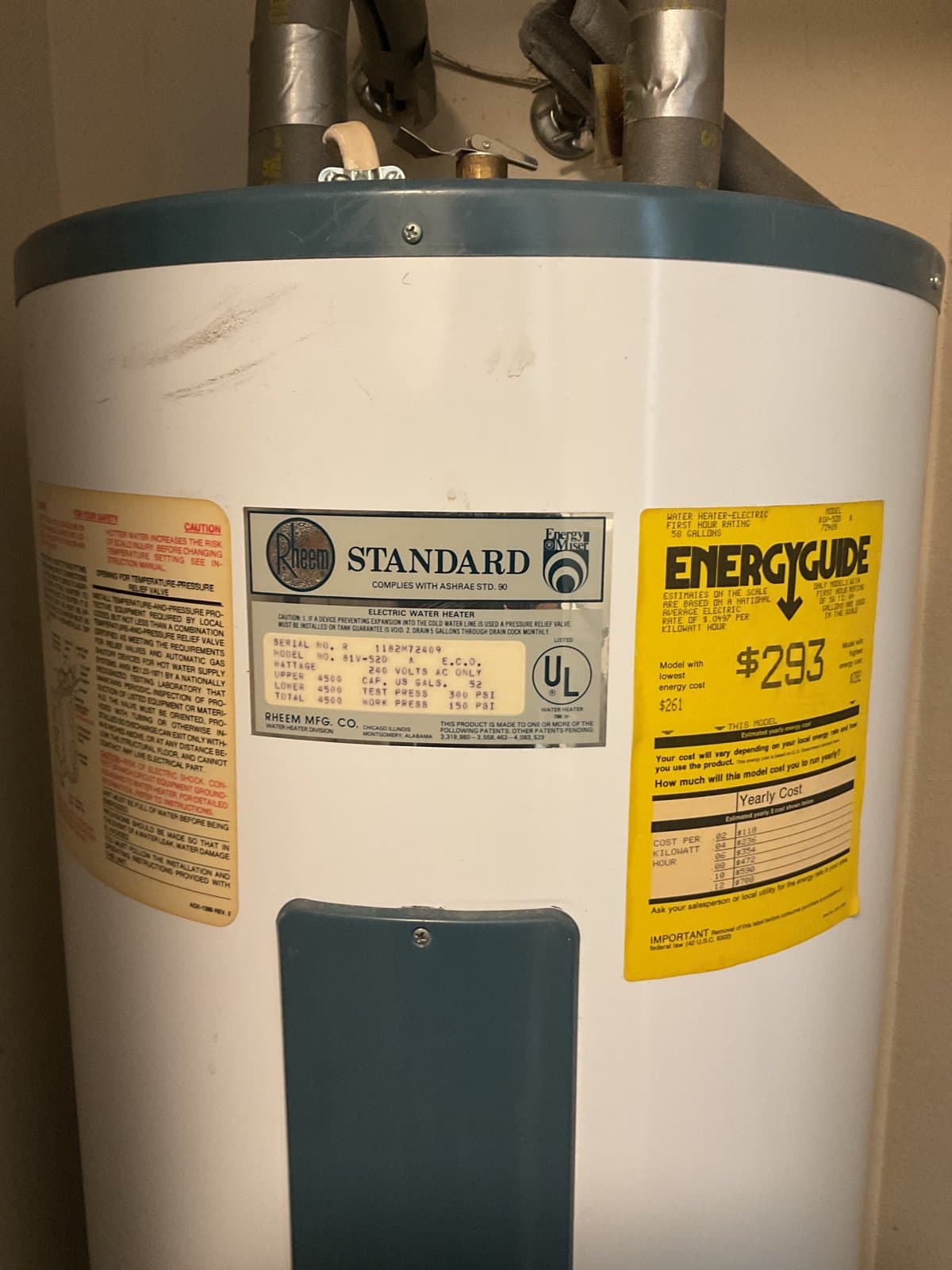
If you're thinking about water heater replacement in Austin, your heater has probably been dropping hints for a while. Tank water heaters almost never die without warning. They rumble, they rust, they run out of hot water a little sooner every month. The Austin replacement we handled in the last two weeks was exactly that kind of heater — still making hot water, but showing its age long before it stopped.
We see the pattern every fall. In just the last two weeks we've replaced a water heater here in Austin, flushed tanks in Austin and Pflugerville, and run VIP flush visits for members — and the replacement, like most of them, was a heater that had been showing its age long before it stopped. Here's how to read the signs on yours while you still get to choose the timing.
1. You can read the age right on the label
Find the manufacturer's label on the side of the tank. It lists a build date or a serial number that encodes one — and the same label shows the warranty term, which matters because a heater still under manufacturer warranty is a different conversation. Most tank heaters in Central Texas last about 8 to 12 years — our hard water works them harder than the national averages assume. A heater past 10 years old isn't automatically done, but it has moved from "maintain it" to "plan for it." Planning a replacement in October, on your schedule, is a very different experience from replacing one in a panic in December with family in the guest room.
2. It rumbles, pops, or knocks when it heats
That kettle-like rumbling is sediment. Austin and Marble Falls water carries a lot of minerals, and over the years they bake into a crust on the bottom of the tank. The burner or element has to heat through that crust, the water trapped under it flashes and pops, and the tank works harder and wears faster for every shower you take.
Early on, a flush can clear much of that sediment out — it's why flushing is part of our membership visits, and we explain the whole routine in our guide to flushing your water heater in Austin. But on an older tank that has never been flushed, years of baked-on sediment often don't come out cleanly, and the rumbling is a sign the tank itself has been taking the punishment. Noise plus age is one of the strongest "start planning" combinations there is.
3. The hot water runs out faster than it used to
Showers that used to be fine back-to-back now end lukewarm, and the second load of laundry gets a cold rinse. Sediment takes up room in the tank and insulates the water from the heat, so a 40-gallon tank slowly becomes a 30-gallon tank that costs more to run. If nobody's usage has changed but the hot water has, the heater is telling you it's losing capacity — and lost capacity doesn't come back.
4. Rusty water, or rust on the tank itself
Run the hot tap into a white sink or tub. If the hot water comes out discolored and the cold doesn't, the rust is coming from inside your tank — the lining has worn through and the steel underneath is corroding. Rust streaks, dampness, or crust around the fittings and the base of the tank tell the same story from the outside. A corroding tank can't be repaired back to sound; it can only leak later instead of sooner. This is the sign to take most seriously, because it's the one that ends in water on the floor.
5. You've repaired it more than once in the last year or two
A heating element here, a thermostat there — individual repairs make sense on a younger heater. But when repairs start stacking up on a tank that's also old, noisy, or rusty, you're maintaining a heater that's already on its way out. The honest question isn't "can this be fixed?" — it usually can — it's "what am I buying with this repair?" On a 12-year-old tank, the answer is often just a few months.
6. There's moisture around the base
A little condensation on a cold-fill day is normal. Puddling that keeps coming back, a damp ring that never dries, or mineral crust built up around the base seam is not. Tanks leak from the inside out as they corrode, and a slow weep at the base is the early version of the failure that floods garages and closets. If you find water, note whether it's coming from a fitting up top (sometimes fixable) or from the tank body itself (that's replacement). And know where your main water shutoff is before you need it — in the Austin area it's typically buried near the curb, right after the meter box, on the house side of it.
7. The T&P valve or drain valve won't behave
The temperature-and-pressure relief valve is the tank's safety valve. If it drips constantly, weeps after every heat cycle, or won't open and reseat when tested, that's not a quirk — it's a safety device asking for attention. Drain valves that drip or won't close after a flush are smaller tells of the same aging. A plumber should look at a misbehaving T&P promptly on any heater; on an older tank, it's one more vote for replacing rather than patching.
So — repair, maintain, or replace?
Here's the simple version we give homeowners at the kitchen table:
- Under 8 years old, no rust, no leaks: maintain it. Flush it, check the anode rod, keep the sediment out.
- 8 to 12 years old, noisy or losing capacity: get it looked at and start planning. You may have good time left — but decide on your terms, because the capacity you're losing is already costing you more to run.
- Over 10 years old plus rust, moisture, or repeat repairs: replace it before it chooses the date for you.
And a Central Texas timing note: cold groundwater in winter makes every heater work harder, and a full house over the holidays doubles the demand. October is the cheapest month of the year to deal with a tired water heater — not in dollars, but in choices. You have all of them right now.
Think yours is showing its age?
We'll come look, tell you honestly whether it's a flush, a repair, or a replacement, and go over your options before any work starts — in writing, so you can sit with them before you decide — including tankless, if your household's hot-water pattern fits it better.
Call for your free estimate visit: (512) 233-6590 in Austin, (830) 460-3565 in Marble Falls.
Economy Plumbing — serving Austin and Marble Falls since 2012. TX Master Plumber #M-41147.