
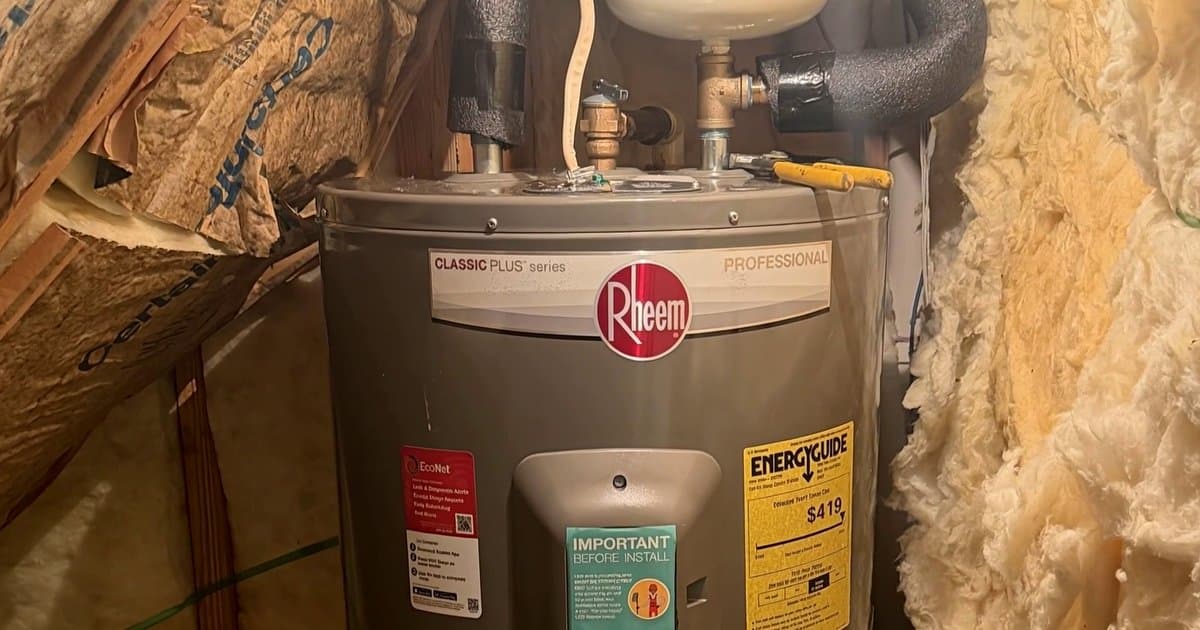
Watch the film version: 5 Signs Your Water Heater Needs a Flush — on YouTube
Your water heater is trying to tell you something. Tank heaters talk in noises, shorter showers, and funny-smelling water — and almost everything they're saying comes back to one word: sediment.
Central Texas water is hard — really hard. Once heated, its minerals settle out and collect in the bottom of the tank, a little more every day. That sediment layer makes the heater work harder, hold less, and die younger. A flush — draining the tank and rinsing the sediment out — pushes back on all of it.
Here are the five signs you've waited too long, what each one means inside the tank, and the honest answer on whether you can handle it yourself.
First, what a flush actually does
A flush is not a magic treatment. It's housekeeping: power or gas off, a hose on the drain valve at the bottom of the tank, and the tank emptied so the water carries the loose sediment out with it. Rinse until the water runs clear, then refill and bring it back up to temperature.
What that buys you: the sediment layer is gone, so heat moves into the water properly, the noises stop, and the parts that were cooking in sludge get a break. What it does not buy you: a flush cannot repair a tank already rusting through or leaking. It's maintenance, not a cure — which is why the signs below split into "flush it" signs and "get it looked at" signs.
Sign 1: It's making noise
Popping, rumbling, crackling sounds from the tank are the classic sediment sound. Water gets trapped underneath the sediment layer at the bottom of the tank, boils there, and bursts up through the layer as steam. That's the pop.
- What it means: there's enough sediment on the tank floor to trap water under it.
- Does a flush fix it? Usually, yes — flushing removes the layer, and the noise quiets right down.
- When it's more than a flush: if the noise comes back within weeks of a flush, or you're not sure the tank has ever been flushed, have it checked rather than flushing on a loop.
Sign 2: The hot water doesn't last
Sediment attacks your hot water two ways: it takes up space in the tank, so there's physically less hot water stored, and it insulates — heat has to push through mineral sludge before reaching the water, so the heater takes longer to make more.
- What it means: showers go cold faster than they used to, and recovery between them gets slower.
- Does a flush fix it? If sediment is the cause, yes — you get the tank's full volume and full heating speed back.
- When it's more than a flush: a household that has outgrown its tank (more people, a new soaking tub) won't be fixed by a flush. That's a sizing conversation, not a maintenance one.
Sign 3: Rusty water, or a rotten-egg smell — on the hot side only
Run the hot tap by itself. If the rust color or the sulfur smell shows up only on the hot side, the water heater is where it's coming from.
- Rusty hot water can mean the inside of the tank is corroding. The glass lining that protects the steel doesn't last forever, and once it's breached, the tank starts rusting from the inside.
- A rotten-egg smell usually means bacteria in the tank reacting with the anode rod — the sacrificial metal rod inside the tank that corrodes on purpose so the tank doesn't.
- Does a flush fix it? A flush plus an anode-rod check is exactly the right first move: it tells you whether you're looking at maintenance or the start of a replacement conversation. Don't guess — this is the sign where the check matters most.
Sign 4: Moisture around the base
Dampness, pooling water, or corrosion at the fittings at the bottom of the tank is the one sign here that is not a flush problem.
- What it means: a tank that's wet at the base is often a tank that's starting to leak — from a fitting, a valve, or the tank itself.
- Does a flush fix it? No. No flush fixes a leak. This one needs a real look, promptly, because tank leaks tend to get worse rather than better.
- While you're down there: look — don't pull — at the temperature-and-pressure relief valve, the brass valve on top or high on the side of the tank. It's a safety device, and if it's weeping, dripping, or corroded, that's a safety item, not a cosmetic one. Eyes only; don't test it by lifting the lever on a valve of unknown age.
Sign 5: You can't remember the last time it was flushed
If the answer is "never," you're in good company — and your heater is carrying years of buildup. This one isn't about how the water behaves today. It's about what's happening to the parts you can't see:
- On an electric tank, the lower heating element sits right in the sludge layer and burns out early.
- On a gas tank, the sediment insulates the tank floor from the burner, so the floor itself takes the heat the water was supposed to get — it cooks the tank.
- Does a flush fix it? A flush still helps a heater that's been neglected — with one caution, in the next section, about old tanks never flushed at all.
DIY or call a pro? The honest answer
Both are legitimate — which one depends on the tank, not on how handy you are.
A fair Saturday DIY job: a newer tank that has been flushed before — ideally every year — with a drain valve that opens smoothly. The job itself is straightforward: kill the power at the breaker (electric) or turn the gas control down (gas), let the water cool, hose on the drain valve, drain and rinse until it runs clear, close it up, refill completely, then restore power or relight.
What's genuinely tricky, even if you're handy: a drain valve that has never been opened — old valves stick, weep, or refuse to reseal, and a valve that won't close again turns a maintenance morning into an emergency (stirred-up sediment can also clog the drain line mid-job, leaving a full tank that won't drain and won't seal — the biggest reason an old, never-flushed tank is a pro job). Power and gas discipline matters too: an electric element switched on while the tank is empty or partly empty burns out almost immediately, so the tank must be completely full before the breaker goes back on, and on a gas unit the control needs to be off (or at pilot) before you start. And a tank that hasn't cooled holds a tankful of genuinely scalding water headed down your hose — cooling time is part of the job, not an optional step. Finally, heavy sediment doesn't always leave politely: chunks can plug the hose or the valve, and working that out on a tank with a stuck valve is where DIY jobs go sideways.
Our honest rule, the same one in the video: if your tank is old and has never been flushed, don't just yank the drain valve open yourself — that's the one maintenance job where calling a plumber is the smart move. If your tank is newer and kept up, flush away, and put it on the calendar yearly.
How often, in Austin water?
Once a year. That's the whole schedule. Sediment builds in proportion to how much hot water you run and how hard your water is — and Central Texas water is hard enough that a yearly flush is the cheapest insurance your water heater can get. A yearly-flushed tank runs quieter, keeps its capacity, and lasts longer than one left to fill with rock.
Think your heater is showing one of the five signs?
Call for your free estimate visit: Austin (512) 233-6590 · Marble Falls (830) 460-3565 TX Master Plumber #M-41147 · Economy Plumbing, since 2012 Book: https://plumbersthatcare.com/book